Is Comuna 13 safe at night?
The daytime corridor is crowded and policed. After dark that pattern ends. What actually changes at sunset, and why the working advice is daylight.
 By Andrés Restrepo, Comuna 13 tour guide & cultural specialist
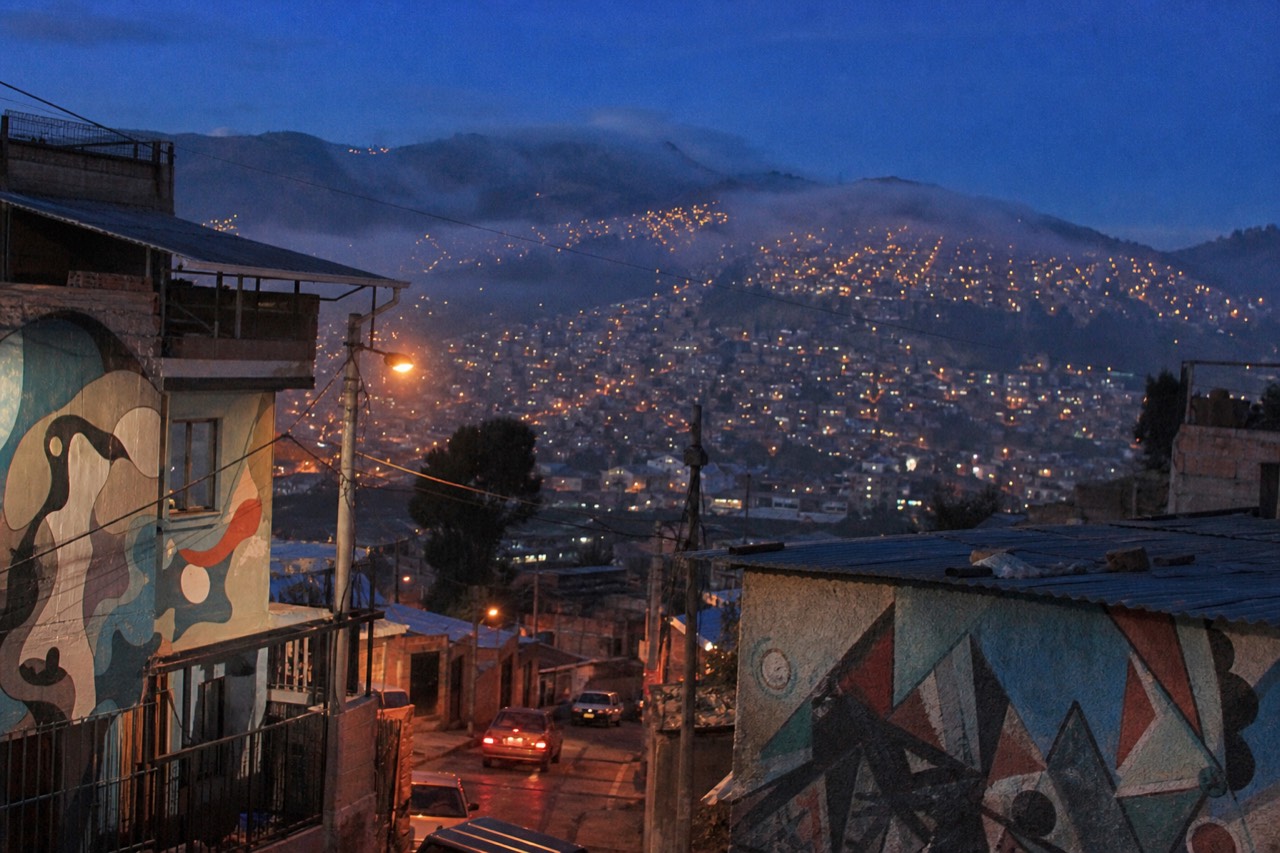
The escalators run about sixteen hours a day. The crowd that makes the corridor feel safe runs about six. That gap is the whole of the night question, and almost nothing written about Comuna 13 addresses it directly, because the honest answer is split rather than clean.
Prices and review counts are August 2026 examples, not live quotes. Itinerary details were rechecked on 15 September. Confirm the final price for your date and party with the provider.
Is Comuna 13 safe at night?
The main corridor keeps some life after dark, with lit terraces and bars, and guided evening visits happen. Wandering the side streets after sunset does not qualify as safe. The daytime pattern of dense crowds, permanent police presence and constant guide traffic is what protects visitors here, and all three fade at dusk.
Everything positive said about Comuna 13's safety is conditional on daylight, and the conditions are worth naming. In the day the corridor carries a share of the million-plus people who walked it in 2024. Police are posted in the mural and escalator zones. Guides work the route continuously and vendors know every face on it. That combination is a deterrent no signage or policy could match.
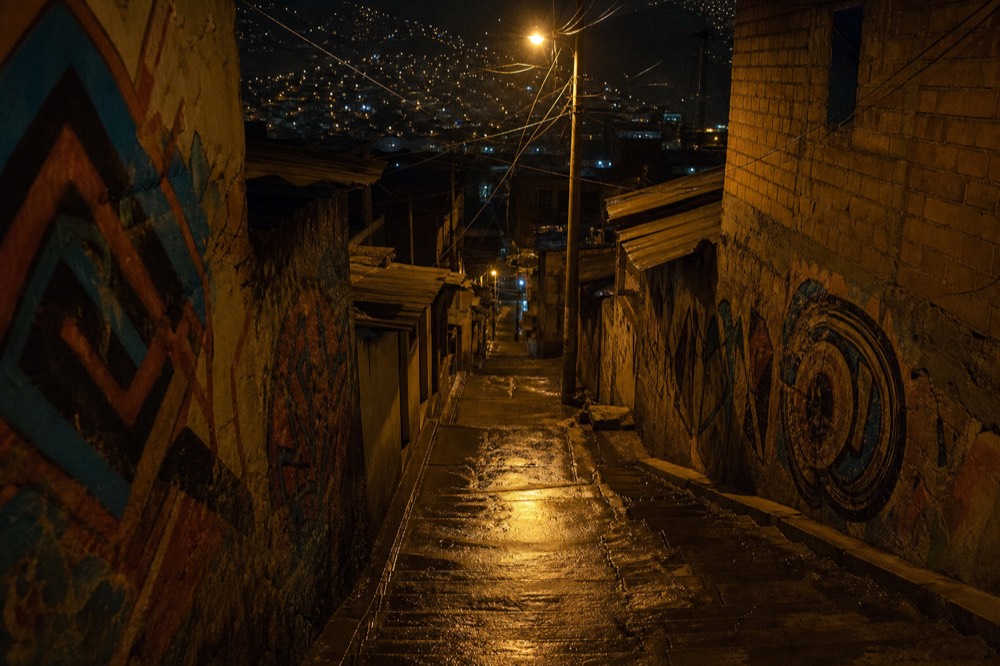
Take those away and you are on a steep residential hillside in a low-income barrio with narrow unlit alleys, no tourist infrastructure and very few people who have any reason to be looking out for you. That is not a claim about a specific threat, and a reliable tour-specific incident rate is not established here; crowds and guiding do not guarantee safety. It is a statement about conditions. The thing that makes the daytime version comfortable simply is not present.
What actually changes after sunset?
Four things at once: the crowd thins, the police presence stops being continuous, the guides and vendors go home, and the visual reason to be there disappears because murals need light. The escalators also stop for the night, which turns the climb into stairs on an unlit slope.
Losing the crowd is the biggest change and the least obvious one. Pickpockets need a crowd, so in one narrow sense an empty corridor removes the commonest daytime risk. What it replaces it with is worse: isolation on unfamiliar terrain where a wrong turn puts you somewhere nobody walks, with a phone in your hand for the torch.
Losing the murals matters more than it sounds. The reason people climb this hill is a hillside covered in street art, and painted concrete in sodium light is not the same thing. Guided evening walks that do run lean on the view of the valley switching on, which is genuinely good, rather than on the art itself.
The transport side changes too. Metro and metrocable services do not run all night, and the Line J cable car keeps its own hours, published on the Medellín metro's service pages, and a late finish can leave you looking for a taxi on a street where street-hailing is exactly what every safety guide tells you not to do. When the escalators run and stop covers the infrastructure side of that timing.
Is there anything worth doing in Comuna 13 in the evening?
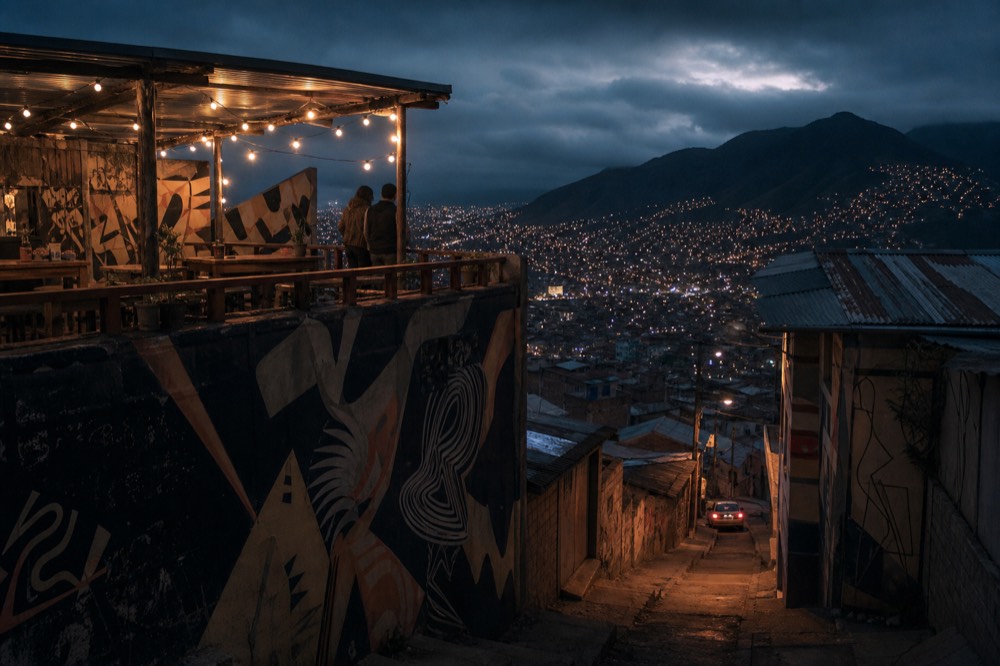
Yes, in one narrow form: a drink on a terrace on the main corridor with the valley lit below, ideally reached and left with a guide or a booked car. That is a legitimate evening. It is an add-on to a daytime visit, not a replacement for one.
The terraces are the real draw. Several sit high on the corridor with an open view across the valley, and watching a hillside city switch its lights on from that angle is one of the better hours in Medellín. Bars on the strip stay open, the music is local, and the mix of residents and visitors is genuinely relaxed on a Friday or Saturday.
The caveats are practical rather than dramatic. Arrive with transport arranged in both directions. Stay on the lit main strip rather than exploring. Keep the drink rule that applies across the whole city: Canada's Colombia advisory flags scopolamine drugging as an ongoing method used against foreigners after a stranger establishes some rapport, and a bar with a view is exactly the setting it describes.
For most people the better plan is simpler. Do the walk in daylight when the barrio is performing, and if it grabs you, come back for a terrace evening with a local. You can check daytime departures for the flagship walk on the live listing, and routes that include the metrocable leg shows which formats build the cable car into the daytime version.
| Factor | Daytime corridor | After dark |
|---|---|---|
| Crowd | Dense, especially 11am to 3pm | Thin, concentrated on the main strip |
| Police presence | Continuous in the mural and escalator zones | Not equivalently described |
| Guides and vendors | Working the route constantly | Mostly gone |
| Escalators | Running, free, around 16 hours daily | Stopped; the climb becomes stairs |
| Murals | The reason to be there | Barely visible |
| Street performances | Dance and rap crews working to a crowd | Finished |
| Main risk | Pickpocketing and phone snatching | Isolation, wrong turns, unlit ground |
| Verdict | Go, ideally 9 to 11am | Main strip only, with a guide, or skip |
What if you are already up there when it gets dark?
Do not improvise a route down. Stay on the lit main corridor, keep the phone away, and go down the way you came up, which is the stretch you already know. Book a car from where you are standing rather than walking toward a main road to hail one.
The most common way a visit goes wrong here is not a confrontation. It is a person who lingered on a terrace, decided to find a shortcut down the hill in the dark, and ended up on an unlit stair alley in a residential barrio with no idea which direction the metro is. The corridor is not signposted, the hillside is genuinely disorienting, and phone maps handle stacked stair alleys poorly.
If you are with a guide, this is a non-issue: they will move the group down before the light goes and put you on transport. If you are alone, set a hard turnaround time in advance and treat it as fixed. Sunset in Medellín happens close to the same hour all year because of the latitude, so the deadline does not move much between seasons.
One more habit worth building for the whole trip: use a ride app or a hotel-arranged car rather than a street hail after dark, anywhere in the city. The city-wide safety answer covers the rest of the evening precautions, and which districts to sleep in covers where to be based when you come back down.
Common questions
Do any tours actually run in Comuna 13 at night?
A small number of evening and sunset formats exist, usually built around the terraces and the valley view rather than the murals. They are the safe way to see the corridor after dark because the guide handles the route, the timing and the transport at both ends. What they cannot give you is the reason most people come: street art in daylight, artists at work, and the dance and rap crews who perform to daytime crowds.
Is it the murals or the safety that makes daytime better?
Both, and they are hard to separate. The art is the point of the visit and it needs light. The safety pattern here is built from crowds, police presence and guide traffic, all of which are daytime phenomena. That is why the recommendation lines up so neatly: the hours when the corridor is most worth seeing are also the hours when it is most comfortable. The hour-by-hour timing guide narrows it further.
Is Comuna 13 more dangerous than the rest of Medellín after dark?
It is a residential hillside barrio rather than a nightlife district, so the comparison is uneven. Areas like El Poblado and Laureles stay busy and lit late, which makes them feel and function differently after dark. Peripheral neighbourhoods across the city, including this one off its main strip, carry more risk simply because activity and lighting drop away. The pattern is about street conditions, not reputation.
So the answer splits cleanly once you separate the corridor from the hillside. A terrace on the main strip with a guide and a booked car is a fine evening. Everything else about this neighbourhood is a daylight proposition, and that is what the full daytime safety guide sets out in detail. If you are picking a slot, take a morning one: all twelve bookable walks list their start times and lengths side by side.
Your next step
Make room for the experience
An editorial starting point — adjust it to your plans below.
Private Comuna 13 night tour
Have a travel date in mind? A four-hour evening itinerary around Comuna 13 with a private guide and Medellín pickup. Check the departure before arranging the rest of your day.
Confirm evening route, cable-car operation and pickup with the operator. Vehicle booking up to six; no safety guarantee.
Choose a date to see scheduled departures. Final availability and price are confirmed on Viator.
Times are local to Medellín. Schedules do not reserve a place.No verified option fits these choices. Adjust the filters or reset to the general recommendations.
Compare options, fit and whole-party costs
Comuna 13 with local guides & snacks — Explore murals, escalators and local stories with a guide who grew up in Comuna 13, plus snacks and coffee or chocolate. Meet at Mestizaje Coffee Gallery. Not suitable for wheelchair users or hearing-impaired travelers.
Comuna 13 True Story & street food — Hear the neighborhood story with a local guide, mural stops, empanadas and a mango popsicle. Meet at Garden Coffee; confirm the address shown for your selected booking option.
Affiliate links support this guide. Product details checked 15 September 2026; confirm your selected option with the provider.