Is Comuna 13 Safe? The Honest Answer for 2026
More than a million people walked the corridor in 2024. The US advisory still reads Level 3. Both are true, and the whole answer lives in the space between them.
 By Andrés Restrepo, Comuna 13 tour guide & cultural specialist
Short answer
Yes, in daylight, on the main tourist route, and best with a guide. That strip is heavily walked and continuously policed, but visitor volume and police presence do not guarantee safety. Pickpocketing in crowds is the genuine risk. Wandering side streets after dark is a different question with a different answer.
More than a million people walked the Comuna 13 tourist corridor in 2024, which made it the most-visited site in Medellín that year. The United States still lists Colombia at Level 3, Reconsider Travel, in an advisory dated March 31, 2026. Those two facts sit awkwardly beside each other, and most of what gets written about this neighbourhood picks one and quietly drops the other.
A useful answer needs both. The advisory is real, and it is national. The corridor is real too: a defined, crowded, permanently policed strip of stairs, escalators and terraces where the risk profile looks nothing like the country-level headline. What follows keeps them separate, ranks the risks that actually turn up, and says plainly where and when the answer flips to no.
Prices and review counts are August 2026 examples, not live quotes. Itinerary details were rechecked on 15 September. Confirm the final price for your date and party with the provider.
Is it safe to go to Comuna 13 Medellin?
Yes, in daylight, on the main tourist route, and better still with a guide. That corridor is heavily walked and continuously policed, but visitor volume and police presence do not guarantee safety. Pickpocketing in crowds is the real risk. Side streets after dark are a separate question.
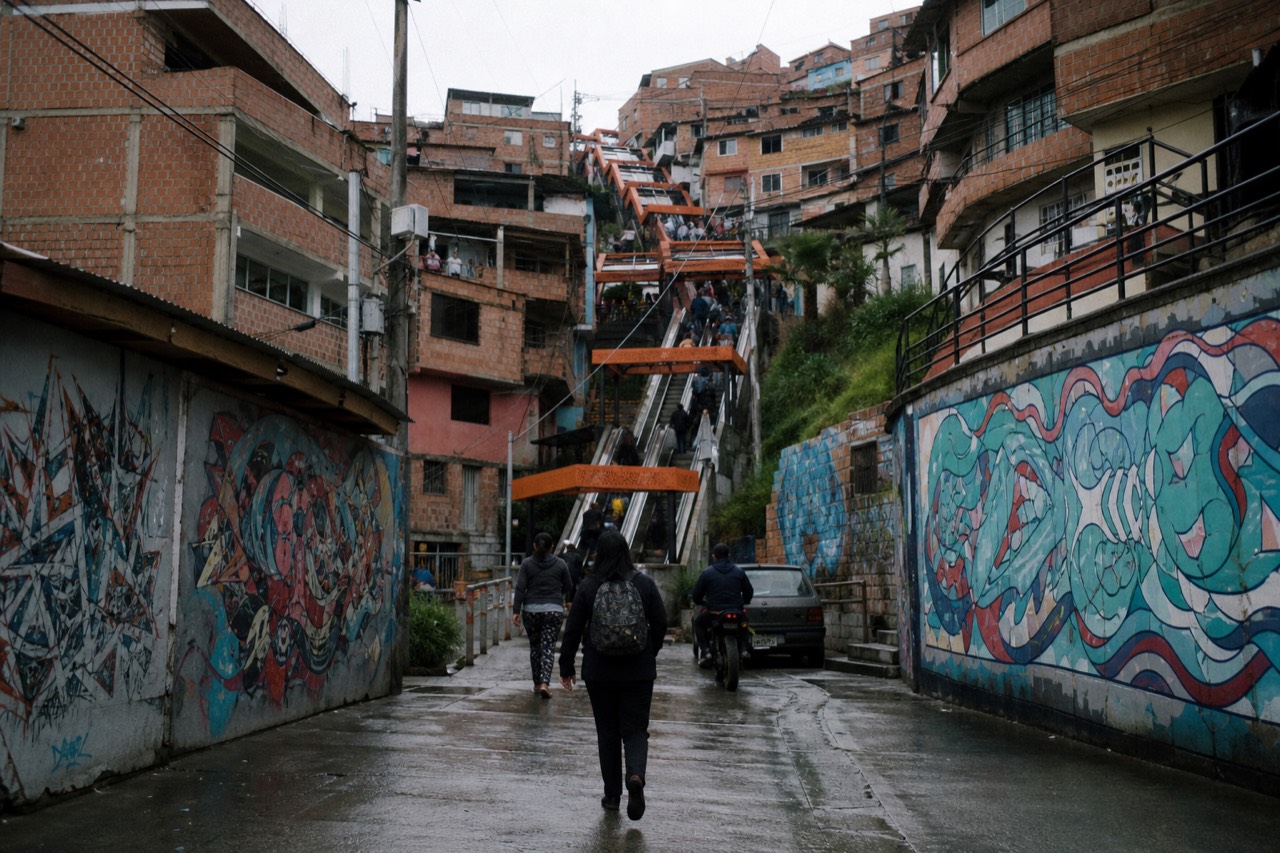
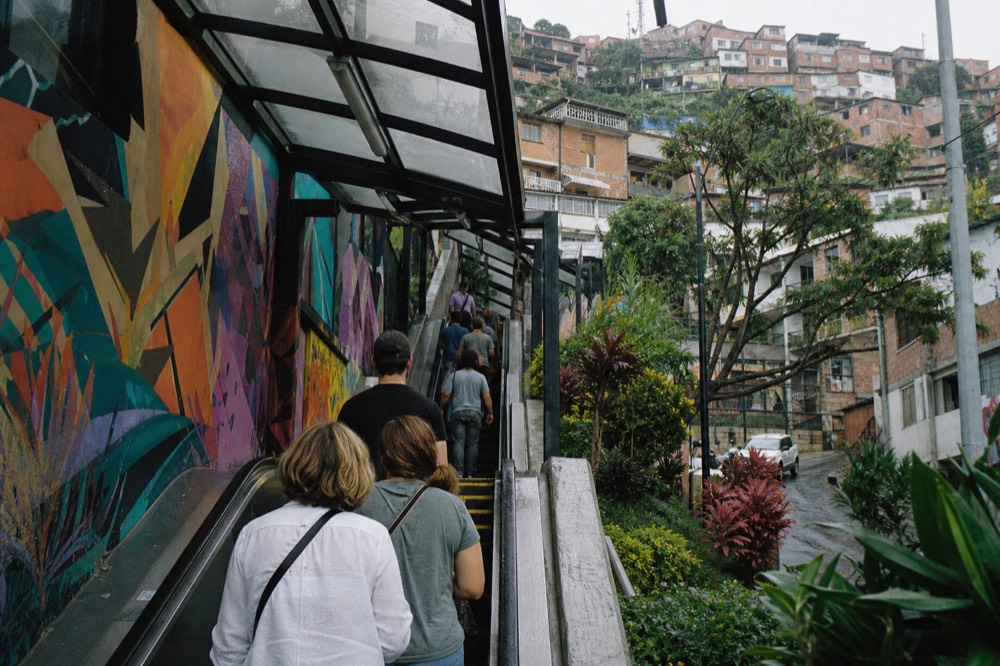
The word "corridor" is doing a lot of work in that sentence, so it is worth pinning down. It means the walked route that runs from the San Javier metro area up through the barrio of Las Independencias along six sections of outdoor escalators, roughly 384 metres of them, past the mural walls, the viewpoint terraces, the food stalls and the dance stages. That strip is a few hundred metres long. Comuna 13 as a whole is a district of tens of thousands of residents spread across a steep hillside, and almost none of it looks like the strip.
Safety here is conditional, not absolute, and the conditions are unusually easy to meet. Daylight. The main route. Reasonable phone discipline. A guide if you want context and a second pair of eyes. Meet those and you are in the same position as the thousands of visitors who have an uneventful, hot, crowded morning here every single week.
The thing that trips people up is that the corridor has no gate, no ticket and no closing time. There is no entry fee and no tourist tax for Comuna 13, which is part of what makes it welcoming and also means nobody screens who is walking beside you. It behaves like a busy public street, because that is exactly what it is. Treat it the way you would treat a packed market street in any large city and the odds are strongly in your favour.
For the timing side of the question, which hours are calmest on the corridor matters almost as much as whether you go at all, and what changes on those streets after sunset is the single biggest swing factor on this page.
What does the Level 3 advisory actually say about Medellín?
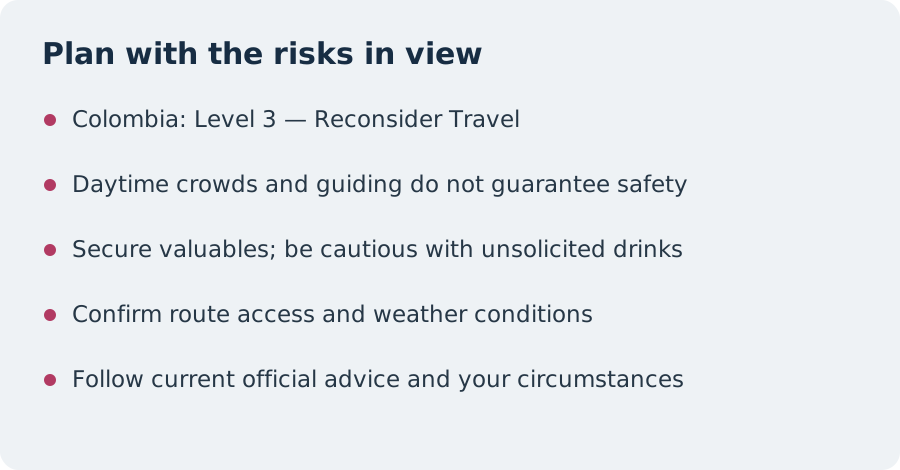
Level 3 applies to Colombia as a whole for crime, terrorism, civil unrest, kidnapping and natural disasters. The Level 4 do-not-travel carve-outs are Arauca, Cauca outside Popayán, Valle del Cauca outside Cali, Norte de Santander, and the 10 km strip along the Venezuelan border. Medellín sits in Antioquia and appears in none of them.
That distinction gets lost constantly. People read "Reconsider Travel" as a verdict on every square kilometre of the country, when the advisory itself spends most of its length carving out the specific departments where the risk is different in kind. Level 3 is the third rung of a four-rung scale, one step below Do Not Travel, and it is applied nationally to a country with regions that genuinely differ from one another.
Medellín's own mention in the March 2026 advisory text is closer to weather than to crime: landslide risk in mountainous cities, which is a real feature of a valley city built up steep slopes in a bimodal rain climate. That is a reason to check the forecast in October, not a reason to cancel.
The Canadian government's advisory adds a specific warning that the US text handles more generally, and it is the one worth reading before you land. Canada's Colombia page flags scopolamine drugging as an ongoing method used against foreigners in Colombian cities including Medellín, typically after a stranger establishes some trust, often through dating apps or a friendly approach in a bar. That warning should not be treated as limited to nightlife; be cautious about unsolicited food, drinks and approaches throughout your trip.
| Area | Advisory level | What is actually flagged |
|---|---|---|
| Colombia, country-wide | Level 3, Reconsider Travel | Crime, terrorism, civil unrest, kidnapping, natural disasters |
| Arauca | Level 4, Do Not Travel | Crime and terrorism |
| Cauca, excluding Popayán | Level 4, Do Not Travel | Crime and terrorism |
| Valle del Cauca, excluding Cali | Level 4, Do Not Travel | Crime and terrorism |
| Norte de Santander | Level 4, Do Not Travel | Crime and terrorism |
| Within 10 km of the Venezuela border | Level 4, Do Not Travel | Border-zone crime and terrorism |
| Antioquia and Medellín | Level 3 only, no Level 4 carve-out | General precautions; landslides noted for mountain cities |
How safe is the tourist corridor during the day?
The main daytime corridor is busy and has a visible tourism presence. That helps orientation, but neither crowds nor police presence establishes that a visit is safe. Theft, violence and other city risks remain possible.
Visitor volume is not protection. Busy landings can make it easier for pickpockets to approach, so keep belongings secure and avoid getting absorbed in filming while moving through crowds.
Police presence in the mural zones, around the escalators and along the main climb is described consistently as permanent during daylight. City authorities have also been formalising the human side of it: Medellín's tourism office has run a certification programme for local guides in the neighbourhood, aimed at both accuracy of the story being told and safety protocols on the route, and the city has referenced a broader tourism security plan in its official communications. The direction of travel is more structure, not less.
What that daylight pattern does not extend to is the rest of the hillside. Step three streets off the walked route and you are in an ordinary low-income residential barrio with none of the tourist infrastructure and none of the eyes. That is not a warning about violence toward visitors so much as a plain statement that the conditions creating the corridor's safety stop where the corridor does.
Rain deserves a mention because it changes the picture more than most people expect. The steps and painted concrete get genuinely slick, the crowd thins, and the covered spots fill up fast. Medellín's wetter runs are April to May and October to November, with May the rainiest month at around 268 mm, so an afternoon slot in those windows is the version of this walk most likely to go sideways for reasons that have nothing to do with crime.
What are the real risks in Comuna 13, ranked?
Petty theft first and by a wide margin: pockets and bags in the escalator crush, and phones taken from hands at the railings. Then citywide risks that follow you everywhere in Medellín, above all drink spiking. Then rain and steep stairs. There is no comprehensive tour-specific incident dataset here that can establish the likelihood of violent crime.
Rank matters because most safety writing about this neighbourhood inverts it. The dramatic risks get the paragraphs and the boring one gets the losses. In practice, the thing that ruins a Comuna 13 morning is a phone that is no longer in your hand, and it happens in the same three or four places every time: on a packed escalator landing, at a viewpoint railing while filming, during a dance show when everyone is looking at the performers, and at the moment of getting on or off the metro.
Phone snatching is worth calling out separately from pickpocketing because the defence is different. A pickpocket needs your attention elsewhere, so a bag worn in front solves most of it. A snatcher needs your phone to be loose in an open hand near a walkable escape line, so the fix is holding it with a strap, filming in short bursts rather than walking with the camera up, and putting it away entirely when you move between spots.
Scopolamine sits in a different category. It is a city-level and nightlife-level risk rather than a barrio one, and the pattern the Canadian advisory describes involves a stranger, some rapport, and a drink, food or cigarette you did not open yourself. Daytime and a tour group do not eliminate the risk of drugging. The rule that protects you is simple and it applies from the airport onward: nothing you did not see poured or unwrapped.
| Risk | How often it shows up | Where it happens | How to cut it |
|---|---|---|---|
| Pickpocketing | The most common issue by far | Escalator landings, dance-show crowds, stall clusters | Bag worn in front, nothing in back pockets, hands free |
| Phone snatching | Common across Medellín generally | Viewpoint railings, street corners, metro entrances | Wrist strap, film in bursts, pocket it while walking |
| Overpaying or pushy selling | Frequent, low harm | Souvenir stalls, costumed photo characters | Agree the price first, carry small notes |
| Scopolamine drugging | Rare for day visitors, real citywide | Bars, dating-app meetups, drinks from strangers | Never accept an opened drink, food or cigarette |
| Getting lost off-route | Occasional | Unmarked stair alleys above and below the escalators | Stay on the walked corridor or take a guide |
| Slips and falls | Seasonal, worst April-May and October-November | Wet steps, steep painted concrete | Grippy shoes, morning slots, handrails |
| Violent crime | No reliable tour-specific rate established here | Risk remains possible | Follow current official advice; a guide is not a guarantee |
Is a guided tour safer than going alone?
A guide can simplify route choices and provide local context. That is a practical benefit, not proof that guided visitors are less likely to experience crime. Independent visits remain possible; precautions apply either way.
The gap widens the less Spanish you have. Guides handle the transactions, the directions, the etiquette around photographing people's homes, and the small negotiations that a monolingual visitor either fumbles or avoids. They also keep the group moving through the crush points rather than standing in them, which is where most of the theft opportunity actually lives.
Cost is not much of an argument against it. Group walks on the listings start around $14 to $22 for three hours, which in Medellín is roughly the price of a decent lunch. Private options run from $79 to $119 and buy you hotel pickup, a car, and a pace you set. Against that, doing it independently costs about COP 4,400 for a metro ride, or around COP 3,820 with a Cívica card, and the escalators themselves are free.
Where solo visits go wrong is rarely the corridor. It is the approach and the exit: getting off at the wrong station, walking up from the wrong side, lingering after the crowd has thinned, or accepting a stranger's offer to show you "the real view" up an alley. If you are set on independence, walking in without a guide covers the route in detail, and how the metro and cable car reach San Javier covers the approach that matters most.
| Factor | With a guide | On your own |
|---|---|---|
| Route decisions | Made for you, corridor only | Yours, and the corridor is not signposted |
| Theft precautions | Secure belongings and stay aware | Secure belongings and stay aware |
| Language | Guide handles vendors and directions | Fine with Spanish, harder without |
| Context and history | The main reason people book | Murals without the story behind them |
| Cost | From $14-$22 group, $79-$119 private | COP 4,400 a metro ride, escalators free |
| Pace | Fixed, 2 to 4 hours typical | Entirely yours |
| Where it goes wrong | Rushed stops, big groups up to 40 | Wrong exit, wrong street, lingering late |
Is Comuna 13 safe for solo travellers?
On the daytime corridor, yes, and plenty of people do it. The practical constraints are the same ones that apply to any solo visitor in a crowded unfamiliar place: no valuables on display, no phone out while walking, no unplanned detours, and an exit before the light goes. Solo at night on these streets is the version to skip.
Solo visitors lose two things a group has. The first is a second person watching the bags, which is why the front-worn bag rule matters more when you are alone. The second is the built-in excuse to decline an approach, so it helps to decide in advance that "no, gracias" is a complete sentence and to keep walking while you say it.
Solo women report the same broad experience on the corridor as everyone else, with the usual caveat that attention and comments happen more often, and more so away from the busy stretches. Travellers who go with a small-group walk rather than one of the forty-person operations tend to describe a calmer experience, largely because the guide is close enough to matter.
The single most common solo mistake has nothing to do with the barrio: it is treating the metro as an afterthought. San Javier at the end of Line B, and the Line J metrocable up to La Aurora, are both busy transit spaces where phones move quickly. Keep it in a zipped pocket on the platform and the ride is unremarkable. For anyone weighing where to sleep as part of the same question, the safest areas to base yourself in the city is the other half of the planning.
Is Comuna 13 safe with children or limited mobility?
Safe, but physically demanding. The corridor is a hillside: escalators cover part of the climb, stairs cover the rest, and the crowd is dense at peak hours. Families do it constantly. Anyone with a stroller, a wheelchair or a bad knee should pick a route built for it rather than improvise on the day.
Children handle this better than adults expect, mostly because escalators outdoors on a mountainside are inherently interesting to a seven-year-old. The friction points are heat in the middle of the day, queues at the busiest landings, and the length of the standard three-hour format. Morning slots solve two of those.
Mobility is the real planning problem. The six escalator sections cover roughly 384 metres of the ascent, and they have been going through phased maintenance through 2025 and 2026, with the stairs alongside staying open whenever a section is down. That is fine if stairs are an option for you. If they are not, an unlucky day can turn a manageable route into an impossible one, and the city posts those works through its own channels rather than through the tour listings.
The private metrocable product lists hotel pickup and accessibility information, but that does not verify every walkway, vehicle transfer or stop for your needs. Contact the operator before paying if stairs or uneven ground are a barrier. You can review the private route and booking options, and the private and pickup-included options compares the formats.
| Visitor | Verdict on the corridor | The thing to plan around |
|---|---|---|
| Solo traveller | Fine in daylight | Phone discipline, exit before dark |
| Solo woman | Fine in daylight | Small group over large; busy stretches only |
| Family, children 6+ | Good, genuinely enjoyable | Heat and queues; go early |
| Family, toddler and stroller | Hard without help | Stairs between escalator sections |
| Wheelchair user | Needs a purpose-built route | Escalator maintenance windows |
| Older visitors | Fine at an easy pace | Around 384 m of climb, uneven steps |
| Nervous first-timer in Colombia | Good starting point | Book a guide, book the morning |
What do people who live in Comuna 13 ask of visitors?
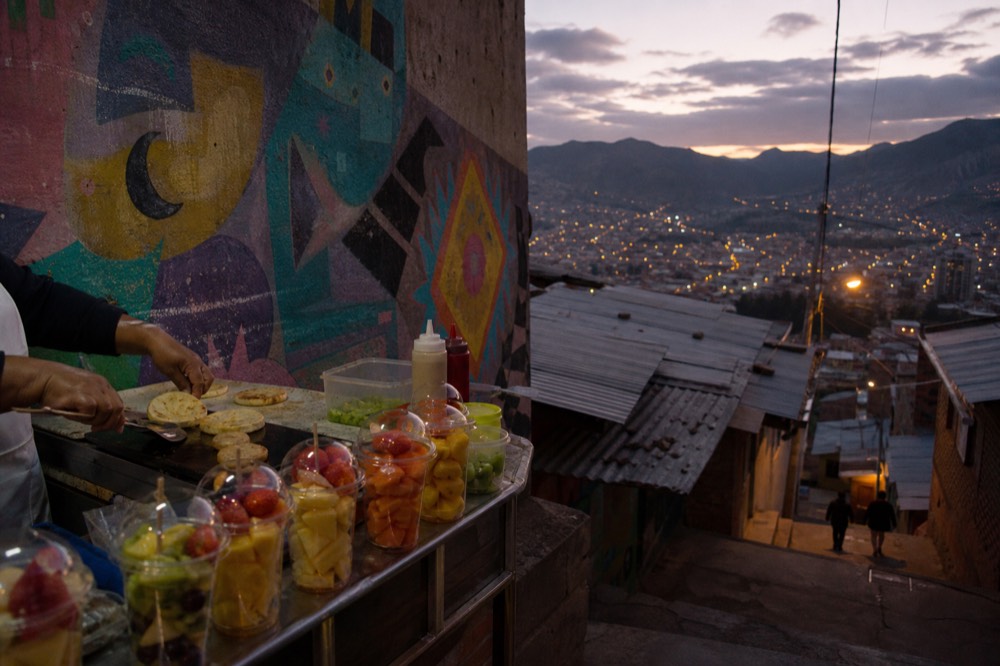
Three things, repeated by guides and residents alike: photograph the murals and the views, not people's homes or faces without asking; spend money in the barrio rather than only walking through it; and remember that the history being narrated is recent, local and still painful for families here.
This matters to your visit in a practical way, not only an ethical one. The corridor works because residents have accepted a permanent stream of strangers through their front doors. Behaviour that erodes that acceptance is also behaviour that draws hostility, and the two most reliable ways to draw it are pointing a camera through someone's window and treating a memorial subject as entertainment.
The history is not distant. Operation Orion in October 2002 was the largest urban military operation in Colombia's recent history, and exhumation work at La Escombrera, the hillside site where families have long searched for the disappeared, continues. Guides who grew up here handle that material carefully. Visitors who crack jokes about it get a cold reception, deservedly. What happened here in 2002 sets the story out properly, and it is the context that makes the murals legible instead of merely colourful.
Money is the other lever. Buy the mango, tip the dance crew, pay the artist for the print. On tip-based walks the working range travellers report is 20,000 to 30,000 COP per person, more like 50,000 for a guide who was genuinely good. How the tip-based walks actually work explains why the "free" label is misleading, and the listings on the GuruWalk marketplace show how many of them run daily.
What should you do and not do in Comuna 13?
Go in the morning, keep the phone stowed while walking, carry small notes and a copy of your passport rather than the original, and stay on the walked route. Do not flash jewellery or a big camera, do not wander uphill alleys alone, do not accept drinks from strangers, and do not stay past dusk.
The do-not list is short because most of it collapses into one habit: do not be the most visible target in a crowd. Medellín's street thieves are opportunists working a percentage, and the percentage drops sharply when there is nothing obviously worth the risk. A phone in a pocket, a plain bag worn in front and no visible chain or watch covers the overwhelming majority of it.
Cash strategy is the small detail that saves the most hassle. Bring enough small notes for snacks, tips and a souvenir, leave the rest in the hotel safe, and skip the ATM stop in the barrio entirely. Card acceptance up the hill is patchy, and the moment of standing at a machine counting notes is exactly the moment worth avoiding.
One habit that is easy to forget: tell someone your plan. Not because Comuna 13 is dangerous, but because a solo visitor on an unfamiliar hillside is a solo visitor on an unfamiliar hillside anywhere in the world. Screenshot the route, note the metro station you came in at, and know how you are getting back.
| Do | Do not |
|---|---|
| Go in the morning, before the late-morning peak builds | Arrive at dusk or plan to linger after dark |
| Wear a small bag in front, zipped | Carry a backpack loose on your shoulders |
| Keep the phone pocketed while walking | Walk with the camera up, filming continuously |
| Carry small notes for stalls and tips | Withdraw cash at an ATM in the barrio |
| Stay on the walked corridor | Follow an unofficial "shortcut" up an alley |
| Ask before photographing people or homes | Shoot through doorways and windows |
| Buy from local vendors and tip the crews | Haggle aggressively over small amounts |
| Wear shoes with grip | Wear sandals on wet painted steps |
| Bring | Leave at the hotel |
|---|---|
| Small notes, roughly 50,000-100,000 COP | Passport original, spare cards |
| One card, in a separate pocket | Jewellery, watches, chains |
| Phone with a wrist strap | Large camera with visible lens kit |
| Water and sun protection | Anything you would hate to lose |
| Copy or photo of your passport | Laptop, tablet, valuables in a day bag |
| Grippy walking shoes | New white trainers you care about |
When should you not go to Comuna 13?
After dark, if you are planning to move around off the main corridor. In heavy rain, when the steps turn slick and the crowd disappears. On a day when local unrest or protest activity is reported. And on a Sunday late morning if crowd crush is the thing you most want to avoid.
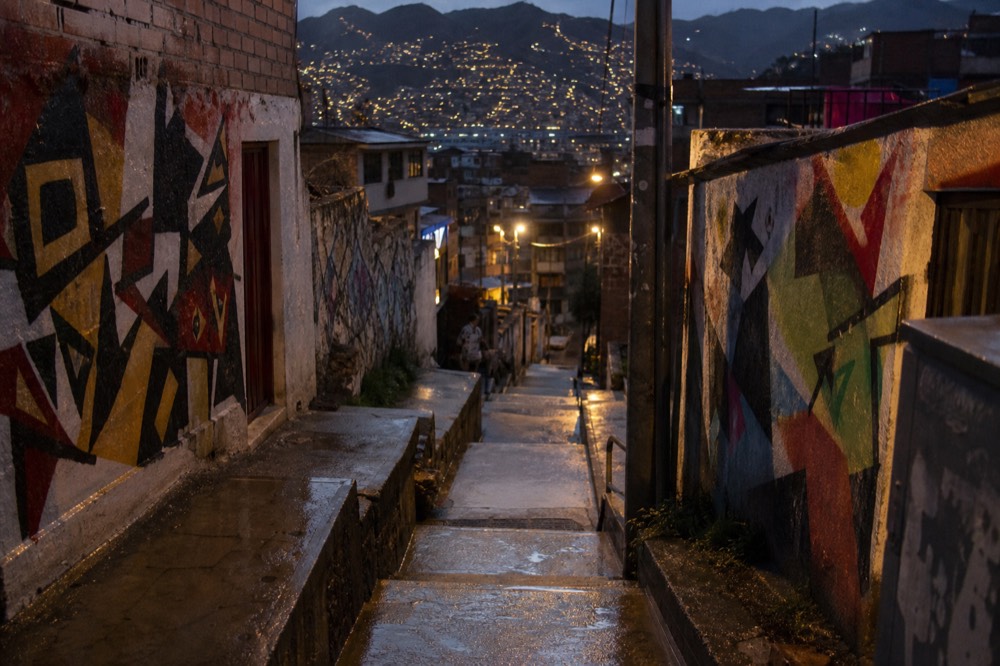
Night is the clearest line on this page. The daytime pattern rests on crowds, police presence and constant guide traffic, and all three thin out after sunset. The main corridor keeps some life, with terraces, lit murals and a handful of evening walks, but the working advice from guides and residents is consistent: daylight, and with someone who knows the route. What changes on those streets after sunset goes through the trade-offs in detail.
Weather is the risk people underprepare for. Medellín sits at around 19 to 22°C year-round, so temperature is never the problem, but the rain arrives hard in the wetter months and it usually arrives in the afternoon. May averages roughly 268 mm against January's 112 mm. Morning slots beat both the crowd and the downpour, which is why almost every experienced recommendation points at the same window.
Crowd timing is a comfort question rather than a safety one, up to a point. Sundays are the busiest day of the week and late morning onward is peak on any day, so a Sunday at noon is the maximum-density version of this walk, with the pickpocketing risk rising in step with the crush. If your group includes small children or anyone unsteady on stairs, that combination is worth avoiding outright.
| When | Verdict | Why |
|---|---|---|
| Weekday, 9 to 11am | Best window | Light crowds, cool air, dry, escalators running |
| Weekday, 11am to 2pm | Fine, busy | Peak heat and peak visitor flow overlap |
| Sunday, late morning to afternoon | Go early or skip | Busiest day of the week, dense crush |
| Any day, 4 to 6pm | Acceptable with a guide | Crowd thinning, light going, rain risk |
| After sunset, main corridor | Only with a guide | Terraces open, but the daytime pattern has ended |
| After sunset, side streets | No | Residential barrio, no tourist infrastructure |
| Heavy rain, April-May or October-November | Postpone to a morning | Slick steps, thin crowds, closed stalls |
| Reported local unrest | No | Conditions change fast, guides will cancel |
Common questions about Comuna 13 safety
Do I need a guide, or can I safely walk the corridor alone?
You can walk it alone in daylight on the main route, and many people do. A guide mainly removes decisions: which turning, where to stop, when to move on, plus the language handling with vendors. If it is your first day in Medellín or you have little Spanish, book one. If you are comfortable in busy cities and read the route beforehand, going independently is a reasonable choice. Either way, the corridor in daylight is the part that works.
Has anything actually happened to tourists in Comuna 13 recently?
This guide does not establish a reliable tour-specific incident rate. An absence of reports is not a safety guarantee. Theft and violent crime remain possible; read current official advice and take precautions.
Is it safe to bring a camera or use my phone for photos?
Yes, with technique. Using a phone or camera exposes it to loss or theft; keep it secure when you are not taking a photograph. The exposure comes from walking with the device out, filming continuously at the railings, or leaving it loose in a hand near a street edge. Use a strap, shoot in short bursts, stow it between spots, and skip the visible multi-lens kit. Also ask before pointing it at residents or their homes.
Is Comuna 13 safe if I do not speak any Spanish?
On a guided walk, entirely. Guides on the listed tours run in English and handle the vendor interactions, directions and etiquette for you. Independently it is harder rather than dangerous: you will miss the story behind the murals, pay less confidently at stalls, and have fewer options if something goes wrong with transport. The mid-priced group walks solve all of that for around $14 to $22.
Should the Level 3 advisory stop me from visiting Medellín at all?
That is a personal call, but read the actual text before deciding. The advisory is national and its specific do-not-travel warnings apply to departments a long way from Antioquia. Medellín appears in it mainly in the context of landslide risk in mountain cities. Most travellers weighing it end up taking the standard city precautions rather than cancelling, and the wider picture for US visitors to Medellín goes through what Level 3 means day to day.
Safety here is not a yes or no so much as a set of conditions, and they are easy ones. Daylight, the main route, a bag worn in front, a phone that stays in a pocket, and a plan for getting back. Meet those and Comuna 13 is one of the most rewarding mornings in Colombia. Ignore them, particularly the daylight one, and you are taking a risk the neighbourhood never asked you to take. If you would rather have the decisions made for you, every bookable Comuna 13 tour is compared in one place, with group size, price and route laid out side by side.
Your next step
Make room for the experience
An editorial starting point — adjust it to your plans below.
Private Comuna 13 & metrocable
Have a travel date in mind? Your own guide, central Medellín hotel pickup and a three-hour Comuna 13/metrocable route. Check the departure before arranging the rest of your day.
Priced per person, with food and tips extra. Confirm the precise pickup address and any mobility needs before booking.
Choose a date to see scheduled departures. Final availability and price are confirmed on Viator.
Times are local to Medellín. Schedules do not reserve a place.No verified option fits these choices. Adjust the filters or reset to the general recommendations.
Compare options, fit and whole-party costs
Comuna 13 with local guides & snacks — Explore murals, escalators and local stories with a guide who grew up in Comuna 13, plus snacks and coffee or chocolate. Meet at Mestizaje Coffee Gallery. Not suitable for wheelchair users or hearing-impaired travelers.
Comuna 13 food & mural walk — Three hours of murals, escalators and local snacks: empanadas, patacón and mango ice cream. Meet at Garden Coffee in Comuna 13; transport is extra. Shared group, maximum 40.
Comuna 13 art & graffiti workshop — Walk with local guides, taste neighborhood snacks and learn spray-paint technique on dedicated practice walls. Three hours, maximum 10, Insiders Foundation meeting point. Not suitable for wheelchair users or hearing-impaired travelers.
Affiliate links support this guide. Product details checked 15 September 2026; confirm your selected option with the provider.